

SHARE:


Moving Beyond Automation to Human-AI Collaboration
According to Gartner, by 2026, 40% of enterprise apps will feature task-specific AI agents, up from less than 5% in 2025. [gartner.com]
This is not just a technology trend — it is a leadership imperative. The future of work is not about replacement; it is about reinvention. Enterprises that unlock the full potential of AI-human collaboration will outperform those that remain focused solely on automation.
Dexian partners with organizations to operationalize this model. We combine intelligent automation with reskilled, AI-ready talent to deliver measurable, business-aligned outcomes.
What Is a Hybrid Workforce? A New Model of AI–Human Collaboration
A hybrid workforce integrates AI agents and human expertise within shared workflows, allowing each to do what they do best:
- AI brings scale, speed, pattern recognition, and repeatability
- Humans bring judgment, creativity, empathy, and strategic reasoning
In this model, AI is not a tool operating on the side — it becomes a teammate inside core business processes.
Organizations that embrace this hybrid structure can consistently:
- Accelerate decision-making
- Reduce operational friction
- Improve accuracy and continuity
- Free human talent for higher-value work
This shift enables enterprises to compete in an environment where the future of work arrives faster than talent markets can adapt.
From Automation to Integration: Reaching Phase 4 Maturity
Most organizations begin their AI journey with tactical use cases — deploying bots to improve efficiency at the task level. But isolated automation has a ceiling. To create lasting enterprise value, AI must evolve from tool to teammate.
Dexian defines this inflection point as Phase 4 Maturity. In this stage, AI systems learn, reason, and interact within workflows. They operate as collaborators, not just executors. Human talent, in turn, transitions into roles that demand creativity, context, and strategic thinking.
- Phase 1 — Task Automation
Bots perform single, repetitive tasks (password resets, notifications). - Phase 2 — Process Automation
AI connects tasks across a workflow, improving efficiency within a department. - Phase 3 — Intelligent Automation
Systems learn from data, predict next steps, and support decision-making. - Phase 4 — AI–Human Collaboration (The Inflection Point)
AI participates in end-to-end workflows, engages in reasoning, and adapts dynamically. Humans shift into roles requiring creativity, cross-functional insight, and strategic oversight.
Phase 4 represents the operational sweet spot where AI and human expertise are fully integrated into business-critical workflows, enabling scalable productivity and continuous innovation.
AI-Native Enterprise Process Example
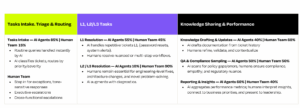
Case in Point: How BA Genie Accelerates Enterprise Productivity
A clear example of Phase 4 in action is BA Genie, a proprietary digital worker developed by Dexian IT Solutions.
BA Genie’s Core Capabilities
BA Genie delivered up to a 60% reduction in documentation and requirements turnaround time by:
- Automatically capturing and summarizing meeting content
- Analyzing unstructured client inputs
- Generating critical project deliverables like business requirements documents and user stories
How Human Roles Shift With Digital Workers
By removing low-value manual tasks, BA Genie enabled business analysts and project managers to redirect their focus toward stakeholder engagement, insight generation, and solution alignment.
Human + AI Role Alignment Across Enterprise Workflows
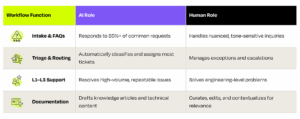
In the hybrid workforce, the goal is not automation for automation’s sake. It is about distributing tasks based on where human judgment and machine intelligence are most effective.
This intelligent division of labor improves speed, accuracy, and cost efficiency — while empowering human teams to focus on innovation and business growth.
The New AI-Enabled Roles Emerging Across the Enterprise
As AI agents take on a growing share of repeatable work, organizations must reimagine core roles:
- Business Analysts become knowledge engineers, curating insights and shaping how AI learns
- Engineers evolve into AI trainers and escalation managers, solving novel challenges and tuning algorithms
- Managers take on the role of AI supervisors, overseeing agent performance, outcome quality, and customer alignment
These new roles do not replace people. They multiply their impact across the organization.
How to Build AI Skills Through Experiential Learning
AI adoption is as much a cultural transformation as it is a technical one. The greatest barrier to progress is not infrastructure; it is confidence.
Dexian addresses this challenge through hands-on, team-based learning programs that allow employees to experiment with AI in real-world scenarios.
Dexian’s AI Transformation Cycle
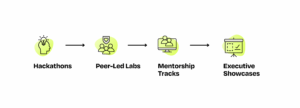
This practical, gamified approach not only accelerates skill acquisition but also fosters enterprise-wide momentum, driving adoption from the ground up and delivering value faster.
Measuring Maturity: The KPIs That Actually Indicate AI Readiness
CIOs and CTOs seeking to quantify transformation progress should focus on business-aligned metrics that go beyond task automation.
Key indicators of success include:
- Time to Prototype: Speed at which teams translate ideas into functioning AI agents or solutions
- Emerging Technology Utilization: Percentage of projects leveraging AI, cloud, and advanced automation
- Innovation Output: Number of features, tools, or concepts delivered through transformation initiatives
- AI Readiness Index: Training hours per employee and adoption rate across key roles
These KPIs measure not only operational gains but also the organization’s capacity to scale AI adoption effectively.
Overcoming AI Resistance by Building Confidence and Clarity
Transformation succeeds when people believe in it.
What Causes Resistance
- Fear of job displacement
- Unclear expectations
- Low familiarity with AI systems
- Lack of visible leadership alignment
- Limited hands-on experience
Change Management Practices That Build Trust
- Position AI as augmentation, not elimination
- Provide role-specific upskilling paths
- Reinforce collaboration KPIs rather than output volume
- Celebrate early wins
- Maintain transparency about goals and impacts
As one Dexian client shared: “The day our support engineers stopped counting tickets and started training AI to handle them, we unlocked real productivity.”
This reflects the essence of readiness: empowered teams, guided by technology, delivering outcomes at scale.
Building the AI-Ready Workforce Starts Now
The hybrid workforce is not an aspirational future. It is a competitive reality.
Dexian helps organizations accelerate toward this future by aligning digital strategy, workforce development, and intelligent automation. Our approach enables clients to:
- Embed AI into enterprise workflows
- Upskill teams through practical learning experiences
- Drive sustained innovation through collaboration between people and technology
Ready to build your hybrid workforce with AI?
Explore how Dexian helps enterprises transition from automation to AI collaboration through strategy, design, and upskilling.
Frequently Asked Questions About AI–Human Collaboration
What is a hybrid workforce and how does AI fit into it?
A hybrid workforce integrates AI agents with human talent to share responsibilities based on comparative strengths.
How does Phase 4 Maturity change enterprise operations?
AI becomes a collaborator, enabling end-to-end workflow integration and enabling humans to focus on strategic work.
Which roles evolve as companies adopt AI?
Business analysts, engineers, and managers shift into knowledge engineering, AI training, and AI supervision roles.
How can organizations measure readiness for an AI-enabled workforce?
By tracking prototyping speed, emerging technology utilization, innovation outputs, and employee AI adoption.
What’s the most effective way to upskill teams for AI adoption?
Experiential, team-based learning that builds confidence and aligns training to real business workflows.
SHARE: